
While the Constitution makes everyone in India eligible to work anywhere in the country, states have used legal loopholes to frame laws.
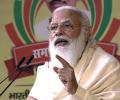
Demoralising the private companies and disregarding their contribution won't do any good to the country or its youth as our experience has shown that private enterprises in mobile manufacturing has lead to every poor family owning a mobile phone now, while the country's private sector in the pharmaceutical space has been serving humanity through vaccines and medicines during Covid times, Modi said.

The BJP would want that by March 2022, when UP votes, the economy starts looking up and it heads into the polls with no other issue distracting from its main poll plank of the construction of the Ram temple in Ayodhya.

The survey showed that women workers fared worse than men when it came to employment recovery (53 per cent versus 57 per cent) and urban areas have been much worse hit despite a quicker bounce back.

'We were among the first organisations to voice our opposition to the three Acts long before anyone else and had sent memorandums collected from 3,000 tehsils across the country to the agriculture ministry to amend the Bills, but nothing was accepted,' says BKS general secretary Badri Narayan Chaudhary.
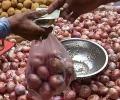
During this time of the year, potatoes and vegetables come from Punjab and Haryana.

It is likely that the party's allies in Tamil Nadu and West Bengal, two of the five states going to the polls in April-May, might insist on allocating fewer seats than they did in 2016, reports Archis Mohan.
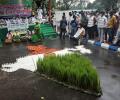
Though the Bills of Punjab and Rajasthan have a lot of similarities, the one approved by the Chhattisgarh Assembly is structurally different. None of the three has tried to address a key demand of the agitating farmers in full, which is to make all payments below the MSP, within and outside mandis, illegal.

A closer look at the data reveals that a lot of the items are not part of this calculation. The notable ones include buffalo meat, marine exports, raw cotton, and plantation crops such as tea, coffee, rubber, etc.
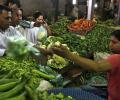
'If you see the composition of items which are causing this spike in prices, most of them have little to do with the kharif harvest, except for pulses and vegetables to some extent.' 'I don't know on what basis the government is claiming that food prices will moderate in the weeks to come.'

Insiders say the BJP is now concerned the LJP putting up a good fight against the JD-U would mean benefitting the MGB in those seats. Moreover, Chirag and Tejaswi are known to be friends, and the former is battling for his political survival.

The reforms will help FPOs procure directly from farmers, something that they have been pressing for long.

When the Centre tries to encroach upon the subjects that are under the prerogative of the state, or where the centre tries to evade from any responsibility guaranteed to a state through a constitutional provision/obligation, it poses a threat to federalism.
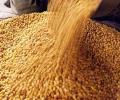
Chana is majorly imported from Australia and Tanzania and it attracts an import duty of 60 per cent. A section of the traders is demanding a reduction in import duty to around 35-40 per cent to tide over any shortage of the commodity as the new crop will start hitting the market only around mid-February.

This year, the monsoon was above normal in almost all parts, except in North-West India, which comprises the major grain producing states of Uttar Pradesh, Punjab, Haryana, Rajasthan, along with states such as Himachal Pradesh, the NCR, Uttarakhand, and J&K.

Data shows that the current system of decentralised marketing and centralised procurement helps Punjab and Haryana farmers the most, while its efficacy in other states has been poor. Experts and farm leaders say success of the laws rests heavily on implementation.
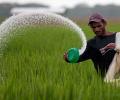
The government's main rate setting panel suggested that this be done in two tranches of Rs 2,500 each in the kharif and rabi seasons.
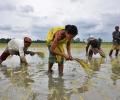
Foodgrains production in 2020-21 is projected to be a record 144.52 million tonnes, which is 0.80 per cent more than the production in 2019-20.
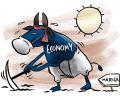
Almost 63 per cent of the increased allocation of around Rs 1.01 trillion has been spent in the first five months of 2020-21.

Opposition parties have alleged that the two agriculture Bills will undermine the safety net provided to the farmers by the MSP system and will lead to their exploitation by big companies.
